“My goal has always been the same: to turn Esterel Caravaning into one enormous bouquet of flowers.”
Thirty years ago, Robert Chaix, President of the Var Outdoor Hospitality Federation and an agricultural engineer, gave me something priceless: an intensive crash course in botany, entirely in Latin. Three or four days in his campsite, plant by plant, scientific name by scientific name. He had explained to me that nurserymen only spoke Latin. He was right.
Following the trail
Armed with this vocabulary, I began staking out my usual nursery to find out who supplied them. That is how I traced the supply chain all the way to a plant broker in Italy, in Pistoia, south of Florence. In that vast valley, dozens of specialist growers cultivate bamboo, cypress, hydrangeas and many others. Each with its own plant, its own speciality, sometimes just one or two varieties.
So I went to Pistoia. I visited one nursery after another. It was a world of endless possibilities: every garden I had ever dreamed of, right there in front of me, ten times cheaper than in France. I started with small orders, and they have grown steadily ever since, for thirty years.
Planting for beauty
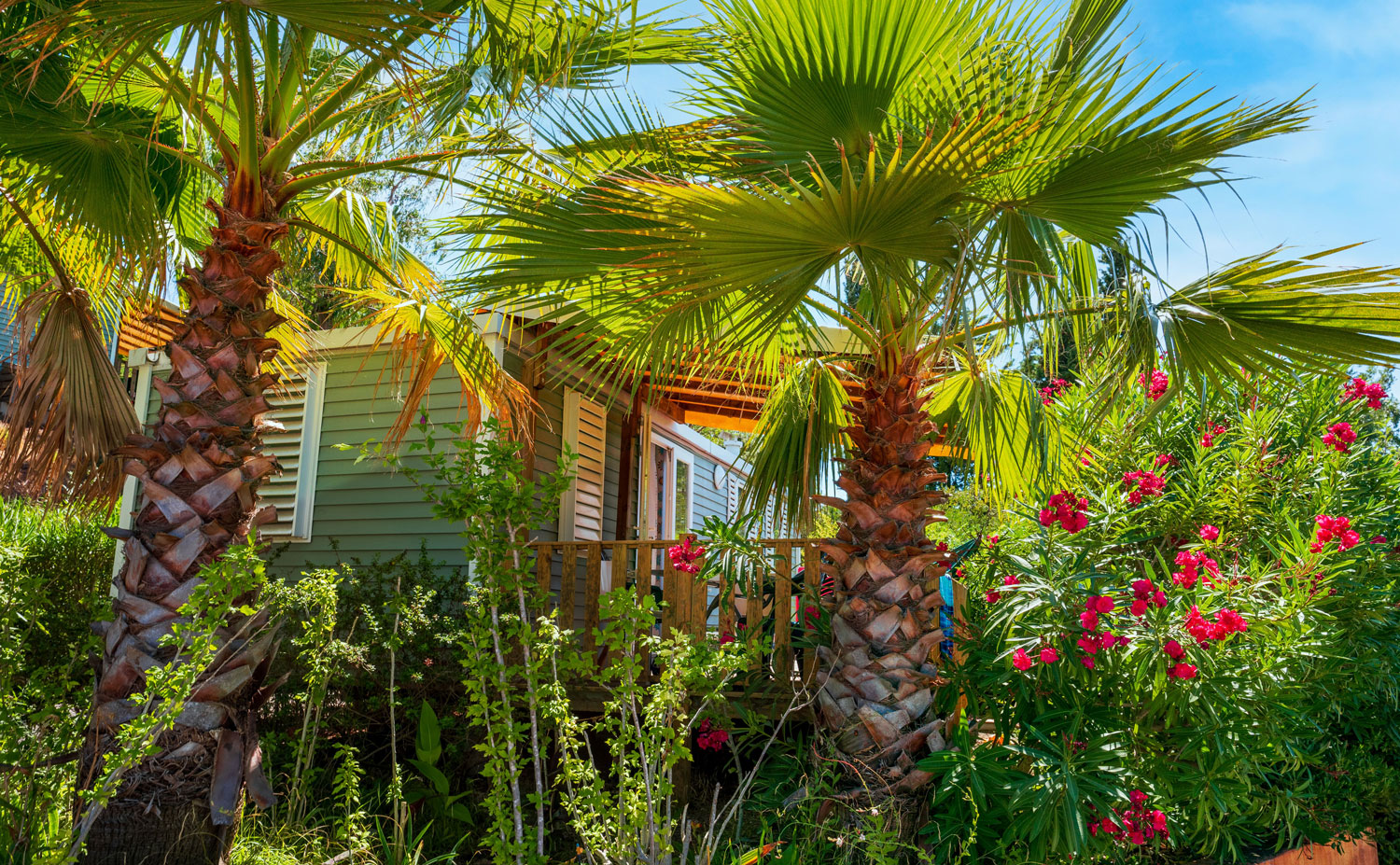
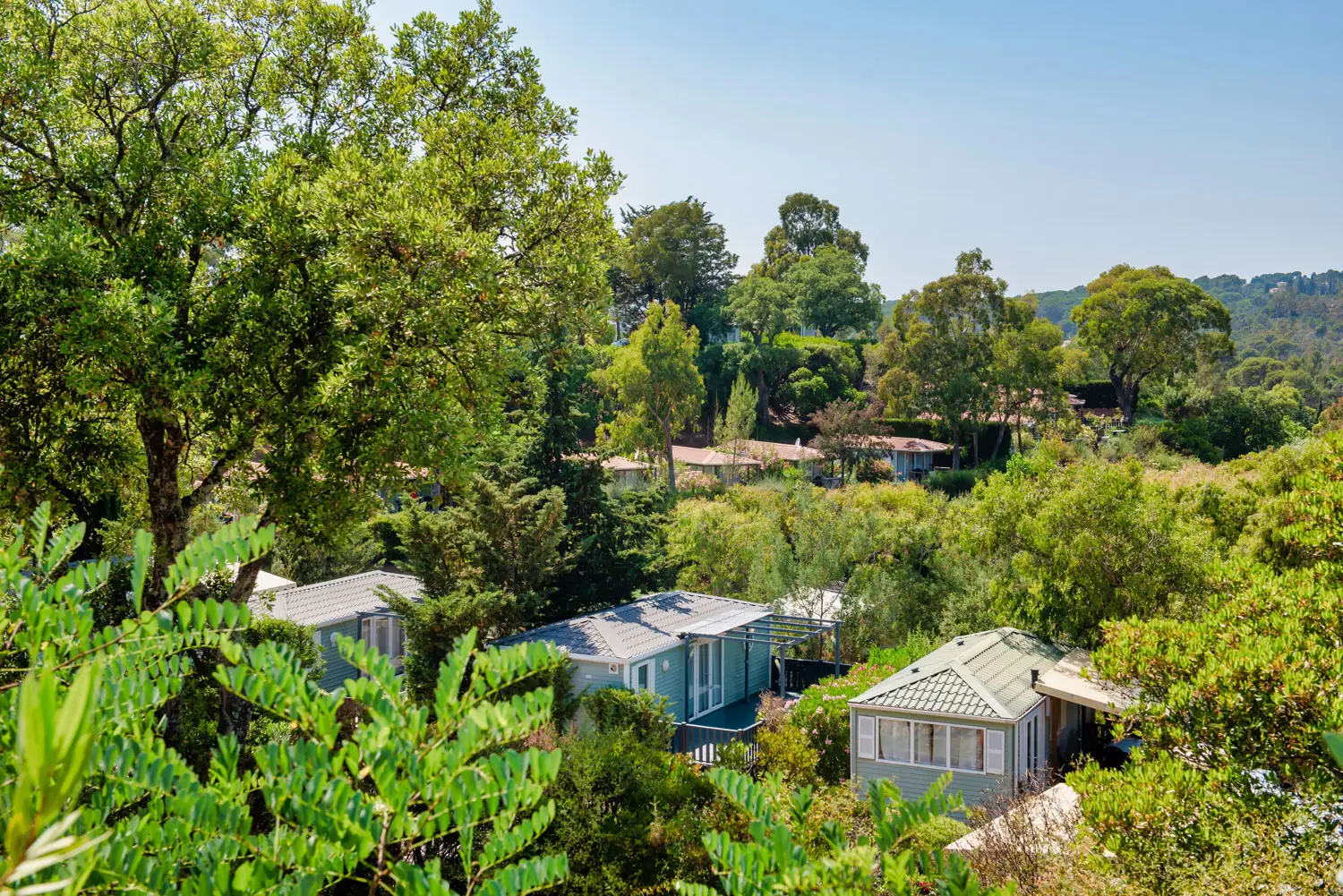
Because the objective has always been the same: to turn Esterel Caravaning into one enormous bouquet of flowers. To give families shade, because shade lowers the temperature on a pitch by several degrees, reduces air conditioning and improves the quality of the stay. To give every guest privacy. And to blend into the Esterel landscape, to disappear into the vegetation, because it has to be said that a campsite without trees, with nothing but caravans and mobile homes, is not very attractive.
Today, more than 85% of the campsite is planted (16 hectares). And this is not an ornamental garden. The plant composition recreates a functioning Mediterranean ecosystem dominated by native species: cork oak, strawberry tree, mastic tree, mock privet, myrtle, rosemary and thyme. Plants that have always known this soil, this sunshine, these dry summers.
Planting to combat climate change
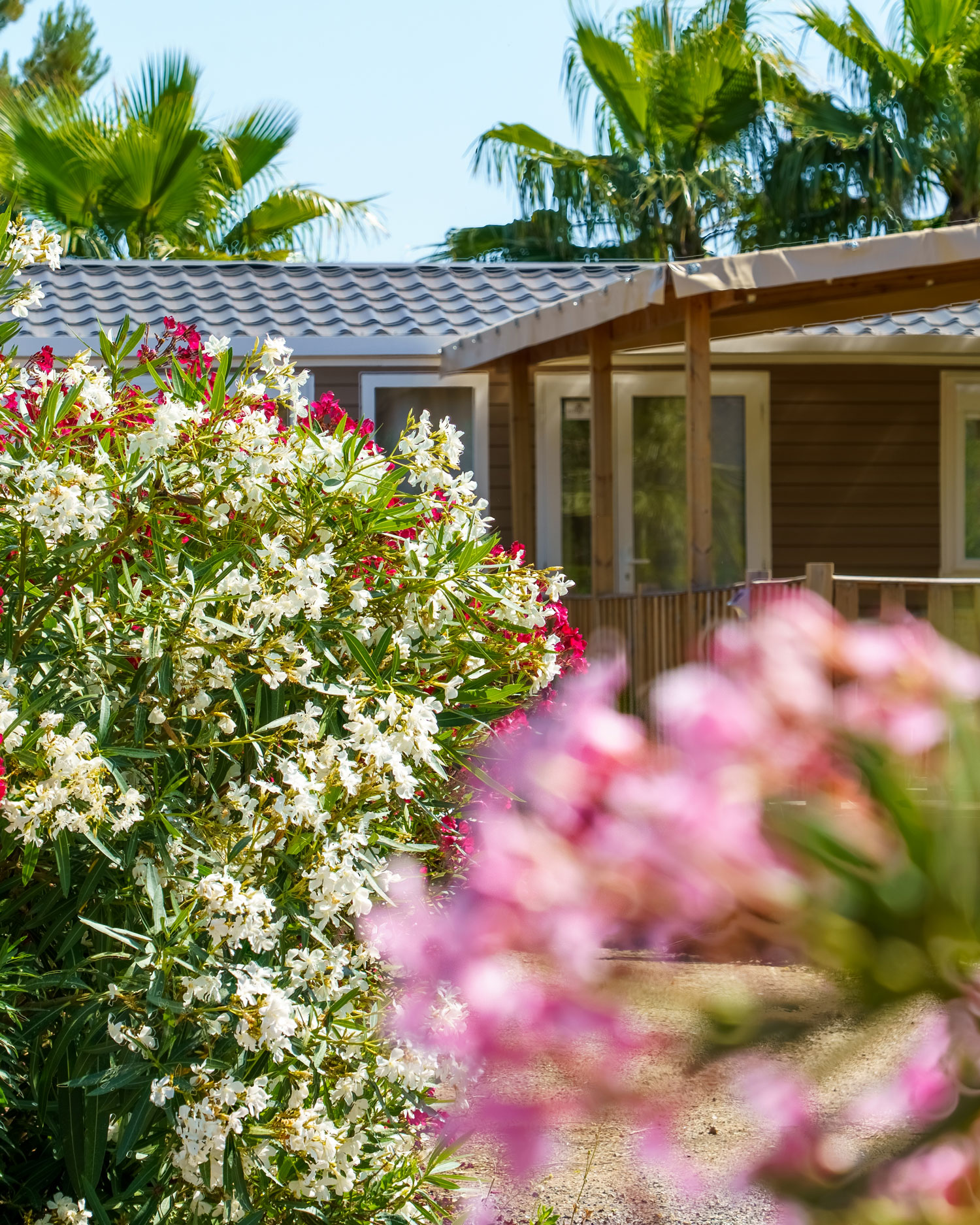
This plant cover does far more than beautify. It regulates the temperature, making a pitch feel up to five degrees cooler at the height of summer, thanks to natural shade and to what botanists call evapotranspiration. It stabilises the soil and improves water absorption during Mediterranean rain events, those violent, brief downpours that can devastate bare ground. It is also home to remarkable wildlife: blue tits, scops owls, foxes, hedgehogs, squirrels and a wide diversity of pollinating insects, whose populations are supported by the beehives on the site. Along a heavily urbanised Mediterranean coastline, our estate acts as an ecological corridor between the Esterel Massif and the sea, a living buffer zone, rare and precious.
Over the years, and with the climate challenges, I have moved towards plants that are even better suited to drought. The oleander, which covers the embankments from June to September without a single drop of water. The lantana, those little balls of yellow, orange and red, impossible to stop. And the palm trees, between 100 and 200 Washingtonia robusta planted every year, which bring an exotic touch, need little water and delight the bees with their clusters of fruit.
290,000 plants
Last year, I had the whole estate counted. The result: more than 290,000 plants, shrubs and trees on the campsite. Enough to allow me to calculate our carbon offset. Since 2008, Esterel Caravaning has followed a CSR approach. The idea has always been to offset the carbon footprint of the families who come here.
An incredible team
None of this would exist without them. Willy, Stéphane and Jimmy have cared for this green heritage for more than twenty years. They know every tree, every flower bed, every little quirk of this garden. They are the ones who, every winter, plant, prune, nurture and prepare everything you see when you arrive in spring. The bouquet of flowers is their work too.
Between us: The very first invoice
My parents had planted long before me. A great deal. And I found the traces of it.
For the 50th anniversary, I dived into the campsite archives and found the very first invoice for plants my parents ever bought. A document dating back to the very beginning, something absolutely incredible to hold in your hands!
But even before that, my parents had applied to the ONF, France’s National Forest Office, for a free allocation of young plants to make the campsite green again. The hills were bare, the earth red, not a single tree. They asked for 30,000 trees. The ONF granted them a certain number, mainly eucalyptus, chosen for their rapid growth.
Those eucalyptus trees are still here. That was the beginning of everything. Before today’s 290,000 plants, before the trucks from Pistoia, before the Washingtonia robusta and the lantanas.
– Aurore